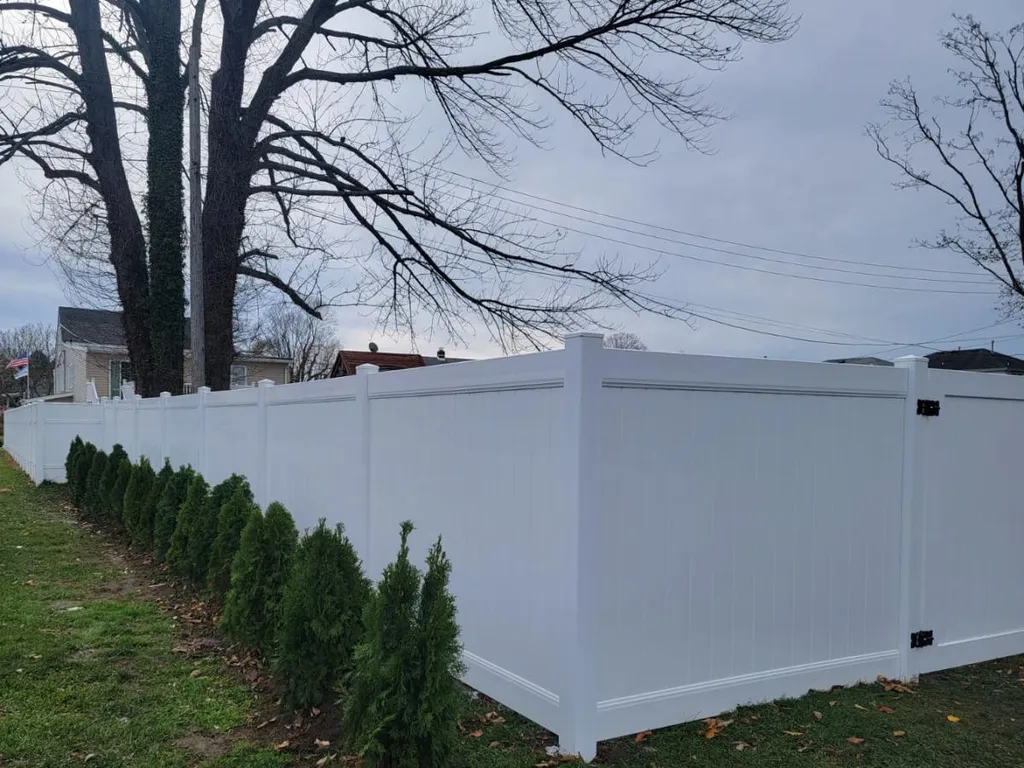
Vinyl fence problems: yellowing, warping and cracking in New Jersey
On this page
Vinyl is the material we install most, and we recommend it to a lot of homeowners. That’s exactly why this article exists: if you’re going to spend five figures on a fence, you should hear the failure modes from the people installing it rather than discover them in year four.
Vinyl fencing does have real problems. Every one of them traces back to either the grade of material or the way it was installed — which means every one of them is avoidable if you know what to ask before you sign.
Yellowing and chalking
The complaint: a white fence that has drifted to cream, or that leaves a white residue on your hand when you touch it.
What’s happening. Ultraviolet light degrades PVC at the surface. Given enough sun and not enough protection, the polymer oxidizes — the color shifts and a chalky powder forms on the surface. This is not dirt, and washing doesn’t fix it, because the surface itself has broken down.
What prevents it. Titanium dioxide. TiO₂ is a UV blocker mixed into the vinyl compound, and quality vinyl fence products carry at least 2 parts per hundred resin of it. That single spec is most of the difference between a fence that’s still white in fifteen years and one that’s yellowing in five. It’s also the first thing budget manufacturers cut, because titanium dioxide is one of the more expensive ingredients in the formula.
Extrusion method matters too. Co-extruded vinyl puts a UV-rich outer layer over a structural core, which is efficient. Mono-extruded vinyl carries the same formula all the way through, so a surface scratch doesn’t expose unprotected material underneath. Both work; what doesn’t work is a thin co-extruded skin over a cheap core.
Ask your installer: how much titanium dioxide is in this product, and is it mono- or co-extruded? An installer who can’t answer is quoting you something they haven’t looked into.
Warping and bowing
The complaint: rails that bow outward, or a panel that looks wavy in the afternoon sun.
There are two separate causes, and the second one surprises people.
Heat and unsupported spans. Vinyl expands when it heats up. A long horizontal rail with nothing inside it will bow as it grows, especially on a south-facing run in July. Quality privacy panels use aluminum or galvanized steel inserts in the bottom rail — sometimes in the top rail on taller fences — precisely to prevent this. Panel spacing matters as well: a 6-foot section holds its line better than an 8-foot section of the same material.
Reflected light from low-E windows. This one is genuinely under-discussed. Energy-efficient windows carry a low-emissivity coating that reflects heat. When a window is slightly concave — which happens on double-pane units under pressure differences — it focuses that reflection into a concentrated beam. Those beams have been measured well over 200°F. Vinyl softens and distorts around 160 to 165°F.
The signature is unmistakable: a warped or melted stripe on the fence that moves across the day and matches the reflection from a specific window on your house or a neighbor’s. It also melts artificial turf, trash cans and car trim, so vinyl fencing isn’t being singled out. The fix isn’t the fence — it’s blocking the reflection with an awning, an exterior screen, planting, or an exterior window film made for this. Replacing the panel without addressing the window just gives the beam a fresh target.
If you see localized distortion on one section with the rest of the run perfectly straight, look for a window before you blame the material.
Cracking in cold weather
The complaint: a panel that cracks or shatters from an impact that should have bounced off.
What’s happening. PVC gets harder and more brittle as it gets colder. Below about 10°F — which northern New Jersey hits most winters — a low-grade panel that would flex and recover in June can crack instead. A branch coming down in an ice storm, a snowblower discharge, a basketball, a car door.
What prevents it. Impact modifiers — acrylic or rubber additives blended into the compound to keep it ductile at low temperatures — and wall thickness. Thicker walls resist impact, heat warping and cold cracking all at once. This is the other spec that separates grades of vinyl that look identical in a showroom.
We install for New Jersey winters, so the products we carry are specified for them. A fence bought on price alone from a big-box aisle usually isn’t.
Gates that sag or stop latching
Gates take more abuse than any other part of a fence — swinging, slamming, kids hanging off them. Most sagging vinyl gates aren’t a vinyl problem at all; they’re an installation problem. The gate post wasn’t set deep enough, wasn’t reinforced, or the gate frame has no internal aluminum.
A gate post carries a lever load all day, so it needs to go deeper and wider than the line posts beside it, and below the 36-inch northern New Jersey frost line. Gate frames should be internally reinforced, and hinges should be adjustable so the gate can be brought back into alignment years later without pulling anything apart.
The green film
The complaint: a shady section of white fence has gone green or gray while the sunny sections look fine.
This is the least serious problem on the list. It’s algae and mildew growing on the surface — New Jersey humidity plus shade, nothing more. It isn’t damaging the vinyl and it comes off with soap, water and a soft brush. Our walkthrough is here: how to clean a vinyl fence.
Worth noting because homeowners sometimes see it and assume the fence is failing. It isn’t. Vinyl’s real maintenance advantage over wood holds up — no staining, no sealing, no rot. An hour with a hose once a year is the whole job.
What the warranty actually covers
Most vinyl fence manufacturers advertise a lifetime limited warranty. Read what “limited” means:
- Usually covered: cracking, peeling, blistering, flaking and excessive discoloration under normal conditions.
- Usually not covered: impact damage, storm and fallen-tree damage, damage from reflected light off low-E windows, discoloration from harsh chemicals or pressure washing, and anything caused by improper installation.
That last exclusion is the one that catches people. A manufacturer’s warranty on the material doesn’t protect you if the posts weren’t set right — which is why we back every job with our own lifetime workmanship warranty on top of the manufacturer’s. Two separate promises covering two separate things.
The short spec checklist
Before you sign anything for a vinyl fence, ask:
- How much titanium dioxide is in the compound? (Look for 2 phr or better.)
- Is it mono-extruded or co-extruded, and how thick are the walls?
- Are the bottom rails on privacy panels internally reinforced with aluminum or steel?
- How deep are the posts going, and are gate posts set deeper than line posts?
- What does the manufacturer’s warranty exclude, and is there a separate workmanship warranty?
Any installer worth hiring can answer all five without checking.
Vinyl done to the right spec
We install vinyl across northern New Jersey and we specify it for our winters — UV package, wall thickness, reinforced rails, posts below the frost line. We’ll tell you what’s in the product we’re quoting, and every job carries our lifetime workmanship warranty.
See our vinyl fence styles, read about our installation process, or call (973) 259-5354, Monday to Saturday, 8am to 8pm, for a free written estimate.
Frequently asked questions
Tap a question to read the answer.
Do vinyl fences turn yellow over time?
Does vinyl fencing crack in cold weather?
Why is my vinyl fence warping in one spot?
How long does a vinyl fence last in New Jersey?
Can you repair a cracked vinyl fence panel, or does the whole thing need replacing?
Is vinyl still worth it compared to wood?
Ready to plan your fence?
Get a free, no-obligation quote from a local NJ fence company. We install vinyl, wood, aluminum and chain link fences across Wayne and surrounding towns.
Continue reading
How to install vinyl panel fence – Simple DIY Guide
How to install vinyl panel fence without hiring a pro. Learn the tools, steps, and tips to set up a long-lasting vinyl fence.
Read more
How Much Does It Cost to Install a Vinyl Fence? Guide
Discover how much does it cost to install a vinyl fence, including materials, labor, and tips to save. Complete guide
Read more
How to Clean a Vinyl Fence: Tips for a Bright and Beautiful Fence
Learn how to clean a vinyl fence with easy tips. Discover the best methods and cleaning solutions to keep your fence looking bright and new for years to come.
Read more