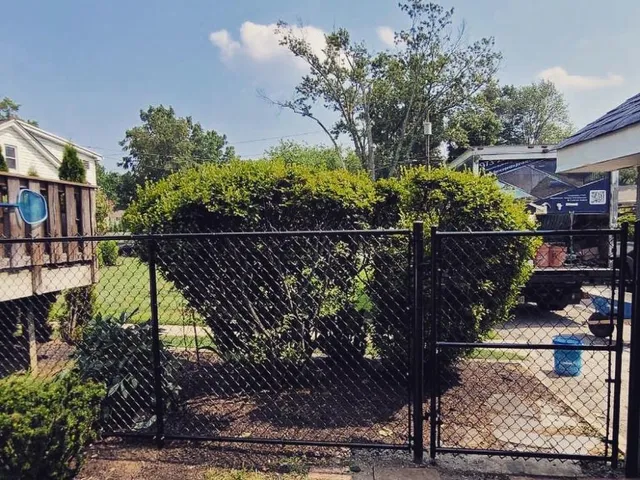
Black chain link vs galvanized: which should you install in NJ?
On this page
Chain link has an image problem, and most of it comes down to color. The silver galvanized fence reads as industrial — a schoolyard, a utility yard, the back of a warehouse. The same fence in black practically disappears against a tree line.
That’s not marketing. It’s the single biggest reason homeowners who ruled out chain link end up installing it anyway. Here’s what actually separates the two, what the difference costs, and the New Jersey towns where the coated version isn’t a preference at all.
What each one actually is
Galvanized chain link is steel wire coated in zinc. The zinc is what stops the steel rusting, and it’s why a galvanized fence lasts decades outdoors. It’s the baseline product, the cheapest per foot, and it’s silver because zinc is silver.
Black chain link is the same galvanized steel core with a bonded vinyl or polyester coating over the top. So you’re not choosing between zinc protection and color — you’re choosing whether to add a second layer on top of the zinc. That’s worth understanding, because it explains both the price difference and the durability difference.
Black is the most common color, but the same coated product comes in dark green and brown. Green tends to vanish against evergreens; brown suits wooded lots; black is the most versatile and by far the most requested.
Why black looks so much better
There’s an optical reason coated chain link reads so differently, and it’s not just taste.
Galvanized wire is reflective. It catches light along every strand, so your eye reads the mesh as a bright surface — a visible screen sitting in front of whatever’s behind it. Black is matte and absorbs light, so the mesh recedes and your eye focuses through it to the yard, the trees, the lawn beyond.
The practical result: a black chain link fence around a backyard mostly disappears from twenty feet away. The galvanized version of the same fence is the first thing you see. Same fence, same function, completely different presence in a yard.
It’s also why black is the default for tennis courts, ball fields and pool enclosures — anywhere you need a barrier that you look through constantly rather than at.
Does the coating make it last longer?
Generally yes, with one caveat worth knowing.
The vinyl layer is a second barrier between the steel and the weather, which matters in New Jersey. Road salt spray along a street-facing run, coastal air, and standing humidity all attack zinc over time; a coated fence gets that much longer before any of it reaches the metal.
The caveat: if the coating is cut or gouged deeply enough to expose the core, moisture can work under it, and a rust spot spreading beneath vinyl is uglier and harder to address than surface rust on a bare galvanized fence. In practice this is rare on residential runs — it takes a real impact, not weathering — but it’s a genuine argument for keeping coated fence away from spots where equipment regularly scrapes it.
Two things matter more than the coating for how long the fence lasts:
- Wire gauge. Lower number, thicker wire. Residential fence is usually 11 or 11.5 gauge; 9 gauge is heavier and noticeably more rigid. Gauge affects longevity and how the fence feels far more than color does.
- The framework. Posts, top rail and tension bars carry the fabric. A heavier fabric on light posts is a badly balanced fence, and — as always here — post depth below the 36-inch frost line decides whether the run stays plumb.
What the difference costs
Coated chain link runs meaningfully more per foot than galvanized. The extra covers the coating process and the matching coated framework — a black fabric on silver posts and a silver top rail looks worse than either option done consistently, so the fittings and framework should be coated too. That’s part of why the gap is larger than people expect from “it’s just paint.”
Where the money goes further: on a modest backyard run, the upgrade to black is usually a small share of the total job, and it’s the change that determines whether you like looking at the fence for the next twenty years. On a long perimeter or a commercial site where appearance matters less, galvanized is a perfectly rational choice and the savings are real.
For how chain link compares against other materials on total cost, see our New Jersey fence cost guide.
In some New Jersey towns, this isn’t your decision
Worth checking before you choose on looks alone, because a few local ordinances have already chosen for you.
Hawthorne permits chain link only when it’s vinyl-coated in dark green, dark brown or black, and only in side and rear yards — never along a street. A galvanized fence isn’t an option there regardless of price.
Wayne doesn’t allow chain link in front yards at all, at any height or finish.
Several other towns we serve restrict chain link by yard, by finish or by both, and corner lots get stricter treatment nearly everywhere. Our town-by-town permit and height guide covers the ordinances we work with most, and we verify the code for your specific address before quoting rather than after.
So which should you install?
Choose black (or green/brown) coated when:
- The fence is anywhere you’ll look at daily — a backyard, a pool enclosure, a front-facing side yard
- Your town requires coated chain link, as Hawthorne does
- You want chain link’s price and function without chain link’s institutional look
- The run takes salt spray from a street or sits in a high-humidity spot
Choose galvanized when:
- The run is utility fencing — a work yard, a storage area, a rear boundary nobody sees
- Budget is the deciding factor and appearance genuinely isn’t
- You’re matching an existing galvanized fence and a patch would stand out
Either way, put the money you save on color into gauge and framework instead. A 9-gauge galvanized fence on properly set posts will outlast a light coated fence on shallow ones, every time.
Chain link done properly
We install both finishes across northern New Jersey, and we check your town’s ordinance before quoting — because in some of them the finish isn’t up to you. Family-owned in Wayne, 15+ years, our own crew, lifetime workmanship warranty on every job.
See our chain link fence options, how we install it, or call (973) 259-5354, Monday to Saturday, 8am to 8pm, for a free written estimate.
Frequently asked questions
Tap a question to read the answer.
Is black chain link fence worth the extra cost?
Does black chain link rust?
What colors does coated chain link come in?
What gauge chain link should I use?
Can I paint an existing galvanized chain link fence black?
Does black chain link work for a pool fence?
Is chain link still a good choice for a backyard?
Ready to plan your fence?
Get a free, no-obligation quote from a local NJ fence company. We install vinyl, wood, aluminum and chain link fences across Wayne and surrounding towns.
Continue reading
Does a chain link fence increase property value?
Does a chain link fence really increase a property's value? It's a valid question that many homeowners ask when considering exterior improvements. The short
Read more
How to paint a chain link fence step-by-step guide
Learn how to paint a chain link fence easily and effectively. This guide covers all the steps, tools, and tips you need for a durable.
Read more
What is chain link fence made of? Learn About Its Materials
Discover what is chain link fence made of, including its steel mesh, posts, and protective coatings. Understand how each part
Read more